


Table of Contents

- What Is an Outstanding Payment?
- Payment Is Outstanding: Why It Happens
- Why Outstanding for Payment Situations Are Increasing for Businesses
- Meaning of Outstanding in Accounting
- Outstanding Payment vs Outstanding Debt Meaning
- Different Letter Templates for Requesting Outstanding Payments
- How Recuvery Helps Businesses Recover Outstanding Payments Faster
- FAQs About Outstanding Payments
Outstanding Payment: Meaning, Examples, and How To Request Overdue Payments Professionally


Quick Answer
Outstanding payment refers to the money owed to a business for products or services. A payment is considered outstanding when an invoice remains unpaid after the due date or within the agreed payment terms, such as Net 15, Net 30, or Net 60.
They’re recorded in a business’s accounts receivable (AR) and followed up through reminders, payment request letters, or emails, until the balance is settled.
Did you know? A survey conducted by NerdWallet found that 37% of Americans were charged a late fee on at least one bill in the previous 12 months, highlighting how delayed consumer payments have become across expenses.
Late or unpaid invoices are one of the most common financial challenges faced by businesses of all sizes. Whether you manage a small team or run a large business, dealing with an outstanding payment is an inevitable part of accounts receivable management.
In this blog, we’ll explore what outstanding payments mean in accounting and business transactions, why they occur, and how businesses can request overdue payments through professional communication, such as payment request emails and letters.
What Is an Outstanding Payment?
An outstanding payment simply refers to money owed to a business that the client or customer has not yet paid. It’s a bill or an invoice that is unpaid even though the payment due date has passed or is approaching.
Outstanding payments are typically recorded in the accounts receivable (AR) section of a business’s financial records. In most transactions, businesses issue invoices with specific payment terms such as:
- Net 15
- Net 30
- Net 60
If the customer does not pay within the specified timeframe, such as 15, 30, or 60 days, the payment remains outstanding until it is settled.
What Does Outstanding Payment Mean in Business Transactions?
In business transactions, this term means that the business has delivered the product or service to the customer, but has not received the corresponding payment yet. Here’s an example:
| Invoice Number | Amount | Due Date | Status |
| INV-1024 | $2,500 | March 1 | Outstanding |
| INV-1031 | $1,200 | March 5 | Paid |
In this scenario, the first invoice is outstanding because the customer has not paid. Most businesses track outstanding payments through the following:
- Accounts receivable systems
- Financial dashboards
- Accounting software
- Aging reports
Tracking such payments helps finance teams identify delayed payments promptly.
Payment Is Outstanding: Why It Happens
Outstanding payments are common, even when businesses set clear payment terms and send invoices on time. Delayed payments are not always intentional, as they may occur due to financial or operational reasons on the customer’s part.
Some of the most common causes of outstanding payments include:
➔ Misplaced or Overlooked Invoices
It’s common for busy organizations to have their invoices buried in emails or accounting systems. If the customer misses it, the payment may remain outstanding until a reminder is sent.
➔ Slow Internal Approvals
Multiple approvals may slow down payments. Sometimes, department managers, finance teams, or procurement officers may all need to authorize the transaction.
➔ Customer Cash-Flow Challenges
The customer’s own financial constraints may delay payments. Further, when businesses face a tight cash flow, they may prioritize certain bills over others.
➔ Billing Disputes or Clarification Requests
Sometimes, customers question invoice amounts, due dates, contract terms, and service details. They may hold the payment until all their disputes are resolved.
➔ Untimely Payment Reminders or Follow-Ups
When businesses don’t have a structured system for sending follow-up reminders to customers, they may intentionally delay payments. Regular communication is critical to ensuring invoices are paid on time.
Why Outstanding for Payment Situations Are Increasing for Businesses
Many businesses report a growing number of invoices marked as outstanding for payment. One major reason is that consumers are struggling to keep up with everyday bills.
Did You Know?
A survey conducted by LendingTree in 2025 revealed that while 72% Americans find it hard to clear their bills in this economy, nearly 48% paid at least one bill late. That’s how common delayed consumer payments have become.
Several other factors contribute to this trend, some of which are listed below.
➮ Longer Payment Cycles
Many businesses, especially service-based ones, offer payment plans, financing options, or extended billing timings to make their services more accessible to customers. While this enhances affordability, it also increases the number of outstanding payments at a given point in time.
➮ Manual Invoicing Processes
Businesses that still rely on manual tracking or spreadsheets often struggle to follow up with their customers efficiently. Without centralized tracking systems and automated reminders, invoices stay unpaid longer than expected.
➮ Economic Pressure
Cash flow struggles and financial uncertainties may force customers to delay payments. The rising costs of living and increasing household debt can make it harder for them to pay their bills on time.
➮ Lack of Structured Collection Processes
Outstanding invoices stay unpaid for longer when there’s no formal system for sending follow-ups and reminders. In such situations, overdue invoices may accumulate over time.
Meaning of Outstanding in Accounting
In accounting, the term “outstanding” explains how unpaid payments affect financial records. It refers to any financial obligation or transaction that has not yet been completed.
Some common accounting uses include:
- Outstanding invoices
- Outstanding expenses
- Outstanding receivables
- Outstanding liabilities
For example, if a business sends a customer an invoice for $3,000 but they have not paid it yet, the amount becomes an outstanding receivable in the business’s accounting system.
Outstanding Payment vs Outstanding Debt Meaning
Sometimes used interchangeably, the terms outstanding payment and outstanding debt carry slightly different meanings and represent different financial situations.
Outstanding debt is a broader term, as it may refer to any financial obligation that has not been repaid, regardless of whether it arises from a loan, invoice, or credit arrangement.
Examples of outstanding debt are:
- Unpaid credit card balances
- Business or personal loans
- Unpaid medical bills
- Vendor balances
- Unsettled customer invoices
On the other hand, outstanding payment, as discussed, refers to an amount or invoice that the customer has yet to pay to a business after availing the product or service. It is tracked in the company’s accounts receivable records and has a defined due date based on the terms and conditions agreed upon by the customer.
For example, if a healthcare clinic performs a procedure and sends the patient an invoice with Net 30 payment terms, the amount remains outstanding until the patient pays.
Therefore, outstanding payments can be a part of outstanding debt if they are unpaid for a long time. The key differences lie in how these obligations are recorded and managed:
| Term | What It Refers To | Typical Context |
| Outstanding payment | Unpaid invoice for goods or services | Accounts receivable |
| Outstanding debt | Any unpaid financial obligation | Loans, credit, bills, invoices |
Outstanding payments are particularly important for businesses that serve customers, as they impact their cash flow and revenue collection. Eventually, these payments can become part of the outstanding debt if unpaid for a long time.
Different Letter Templates for Requesting Outstanding Payments
Businesses often use different types of payment reminder letters when a payment is outstanding, depending on the stage of the collection process. Below are some commonly used letter templates to communicate with customers. You may tailor/alter the language and structure of these letters depending on your business’s customer communication policies.
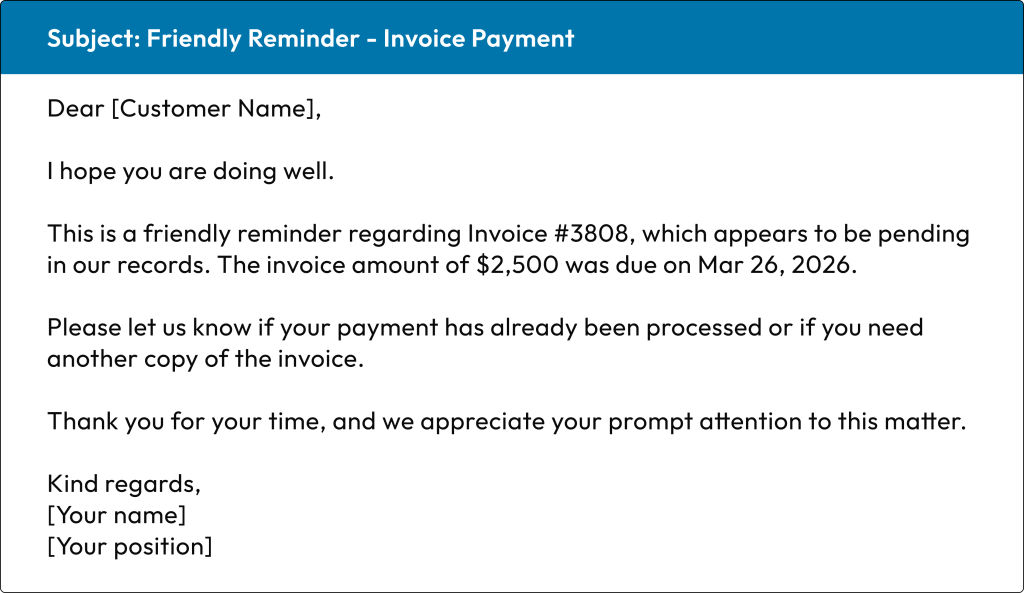
1. A Letter Requesting Outstanding Payment (Friendly Reminder Template)
The first reminder a business sends to the customer after sharing an invoice should be polite and friendly. The delay may simply be due to an oversight.
This template can be used to draft a letter that needs to be sent a few days after the due date. It focuses mainly on confirming whether they received the invoice.
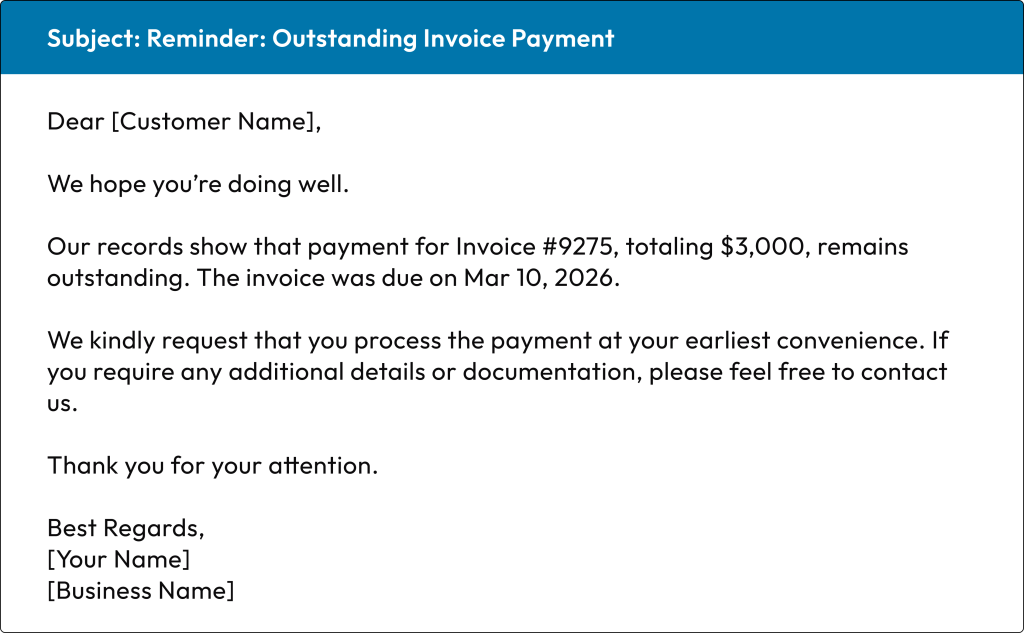
2. A Letter Asking for Outstanding Payment (Standard Follow-Up Template)
This letter template is usually sent when the customer has not responded to the initial reminder. The business now politely asks the customer to arrange the payment soon. The tone remains professional, but slightly more direct.
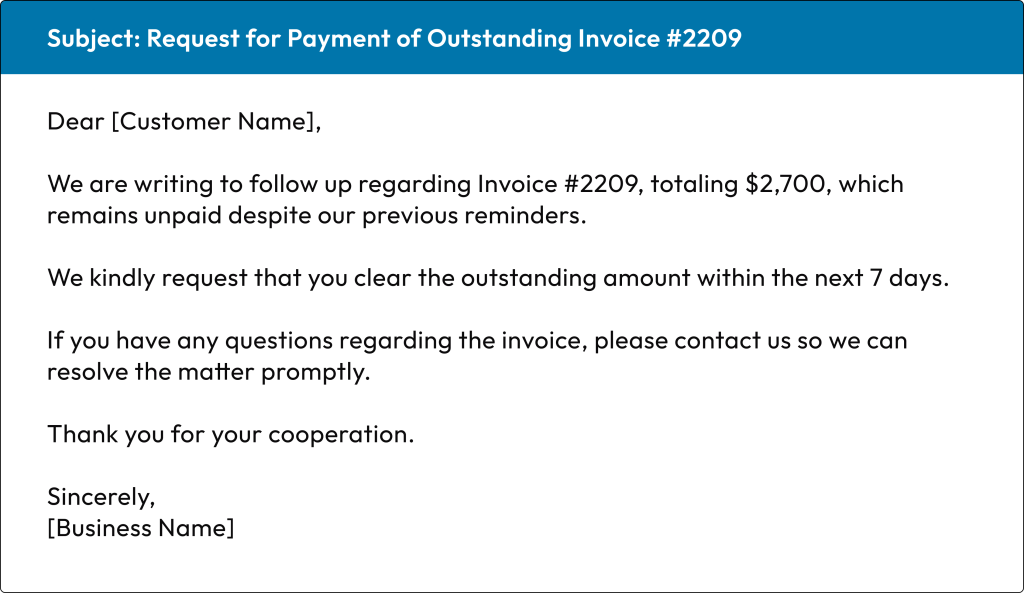
3. Another Letter Asking for Outstanding Payment (Formal Request Template)
This kind of letter is used when early reminder letters or emails have not resulted in payment. The communication at this point becomes more formal and sets clearer expectations for payment.
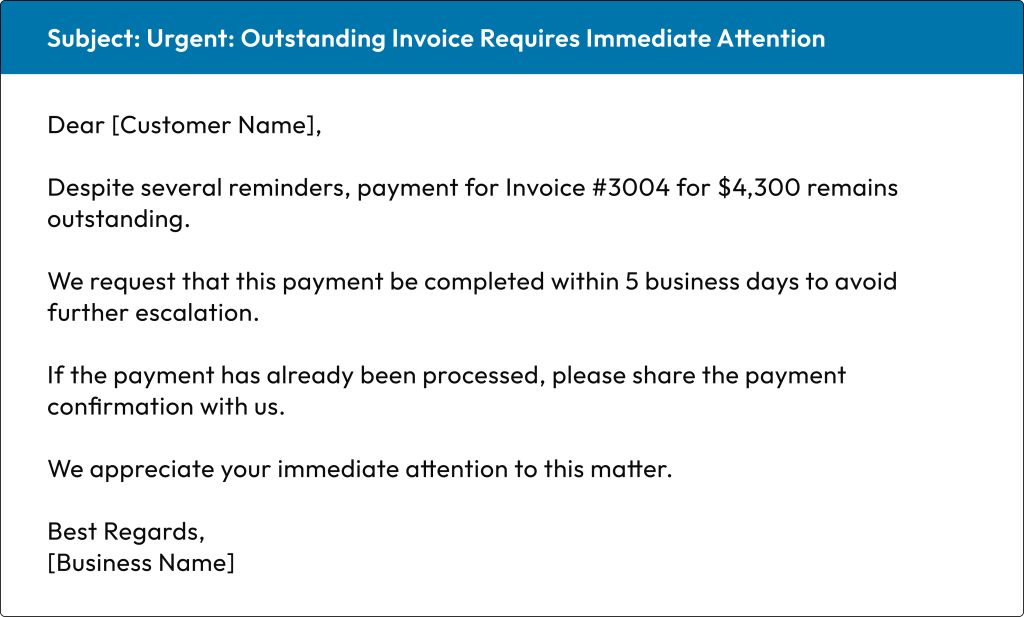
4. Strong Letter/Email for Outstanding Payment (Firm Reminder Template)
A strong letter or email requesting outstanding payment is typically sent when the customer ignores previous communication attempts made by a business. The tone becomes even firmer while still maintaining professionalism. This message clearly communicates urgency and may reference previous reminders.
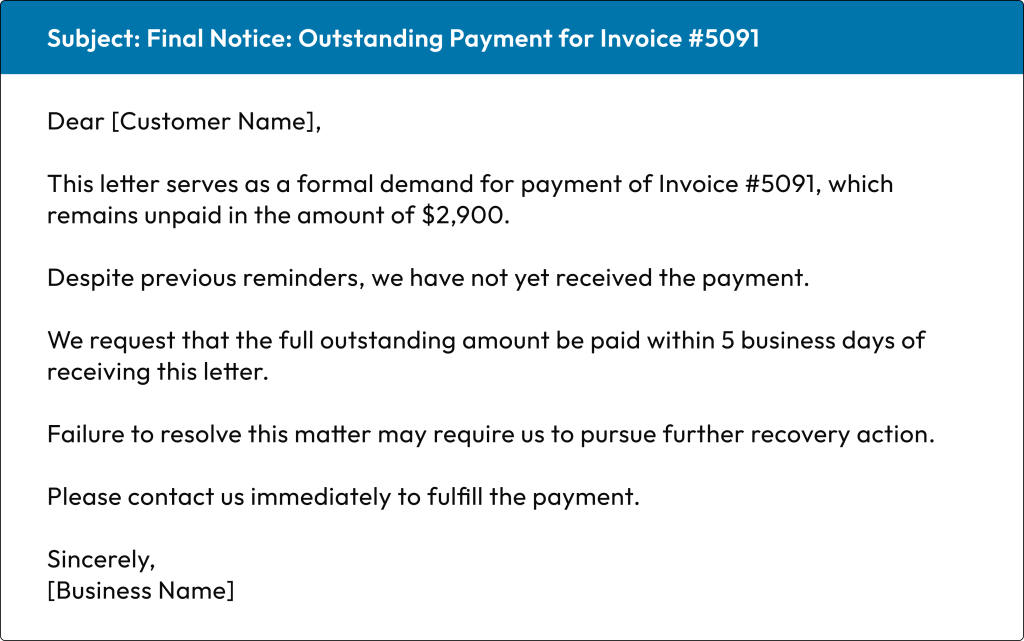
5. Demand Letter for Outstanding Payment (Final Notice Template)
This demand letter template for outstanding payment can be used before a business escalates the matter through formal recovery actions. At this stage, the letter should focus on emphasizing that the payment should be made immediately.
How Recuvery Helps Businesses Recover Outstanding Payments Faster
When payments are outstanding, businesses often struggle with pending follow-ups, manual tracking, and aggressive communication that damages customer relationships.
Platforms like Recuvery modernize the recovery process by blending collections technology and automated workflows with customer-friendly payment tools, all within one system.
Here’s how your business can leverage this new-age platform to streamline the entire recovery process:
| Capability | What Recuvery Does |
| Automated account onboarding | Businesses can quickly upload or sync overdue accounts into the platform, eliminating manual tracking. |
| Branded payment reminders | Customers receive polite, professional reminders through digital channels instead of aggressive collection calls. |
| Self-service payment options | Customers can resolve their balance online or through mobile tools, reducing friction and speeding up payments. |
| AI-powered prioritization | The platform highlights accounts that require immediate attention, helping teams focus on the most important recoveries first. |
| Built-in compliance | Every reminder and communication follows regulatory guidelines, reducing legal risk for businesses. |
| Credit-rebuilding support | Positive payment reporting helps customers rebuild credit after resolving their balance, creating a more ethical collections experience. |
With these features, businesses can recover revenue faster while protecting long-term customer relationships.
FAQs About Outstanding Payments
1. Can a Business Charge Interest on Outstanding Payments?
Yes, businesses sometimes charge interest on outstanding payments if the terms were clearly stated in the invoice or contract. However, the rules for levying interest may vary according to the transaction type and state laws.
2. How Long Can a Payment Remain Outstanding Before It Becomes Bad Debt?
When the outstanding payment seems unlikely to be collected, businesses classify it as bad debt. Many businesses internally review invoices that remain unpaid for 90 to 180 days and decide whether to write off the balance, pursue recovery more stringently, or send such accounts to a collection agency.
3. Does an Outstanding Payment Affect a Customer’s Credit Score?
An outstanding payment itself may not impact a customer’s credit score. However, if the matter is taken to a collection agency or reported to credit bureaus, it can appear on the customer’s credit report and affect their score.
4. What Industries Experience the Most Outstanding Payments?
Outstanding payments are a common concern, especially in industries where services are delivered before the payment is made. Common examples include healthcare providers, dental clinics, home improvement providers, legal services, auto repair providers, and training or education providers.
Share on social media: